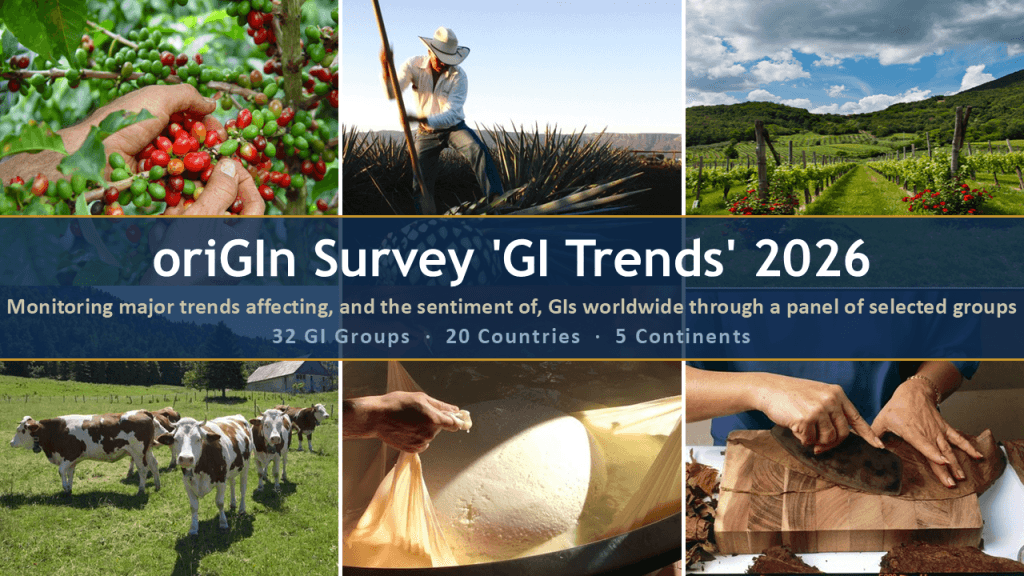
oriGIn – the global alliance of Geographical Indications – today published the results of its annual GI Trends Survey. Now in its fifth edition, the survey monitors the economic performance and strategic priorities of GIs worldwide. The 2026 edition draws on responses from 32 GI groups spanning 20 countries across 5 continents — covering agricultural products, wines, spirits, and crafts – and reflecting the diversity of the estimated 20,000 GIs recognised internationally.
The surveyed GIs report 73.1 billion EUR in turnover, 58.9 billion EUR in export and 640.000 direct jobs. They represent over 1 million KM2 of land and attract some 14 million visitors annually.
Sales performance was divided in 2025: 42% of surveyed GI groups reported growth, while 39% saw a decline, reflecting the combined weight of global trade tensions, tariffs, and geopolitical uncertainty. Production costs rose for 77% of respondents, yet 78% maintained stable workforce levels – underscoring the sector’s structural resilience and long-term employment commitment. Sentiment heading into 2026 is predominantly cautious: 48% of groups foresee unfavorable economic conditions – a more pessimistic reading than a year ago.
This year’s survey introduced a dedicated focus on groups, the operational backbone of the GI system, whose governance, funding, and internal dynamics have until now remained largely undocumented. Key findings include:
- 77% of surveyed groups report high or very high member involvement in strategic decision-making, reflecting the collective, bottom-up governance model at the heart of the GI system.
- 48% of them represent 100% of value-chain stakeholders, confirming strong institutional legitimacy.
- Promotion and legal protection dominate the activity ranking.
“GI groups are a pillar of the GI system – the foundation of its resilience and long-term credibility. The 2026 survey confirms that despite a challenging global environment, these associations remain committed to protecting their names, expanding their markets, and serving their members, thereby generating long-term social, economic and environmental value for their communities. Having identified patterns and best practices of successful groups worldwide, oriGIn will strengthen its capacity-building initiatives”, commented Riccardo Deserti, President of oriGIn.